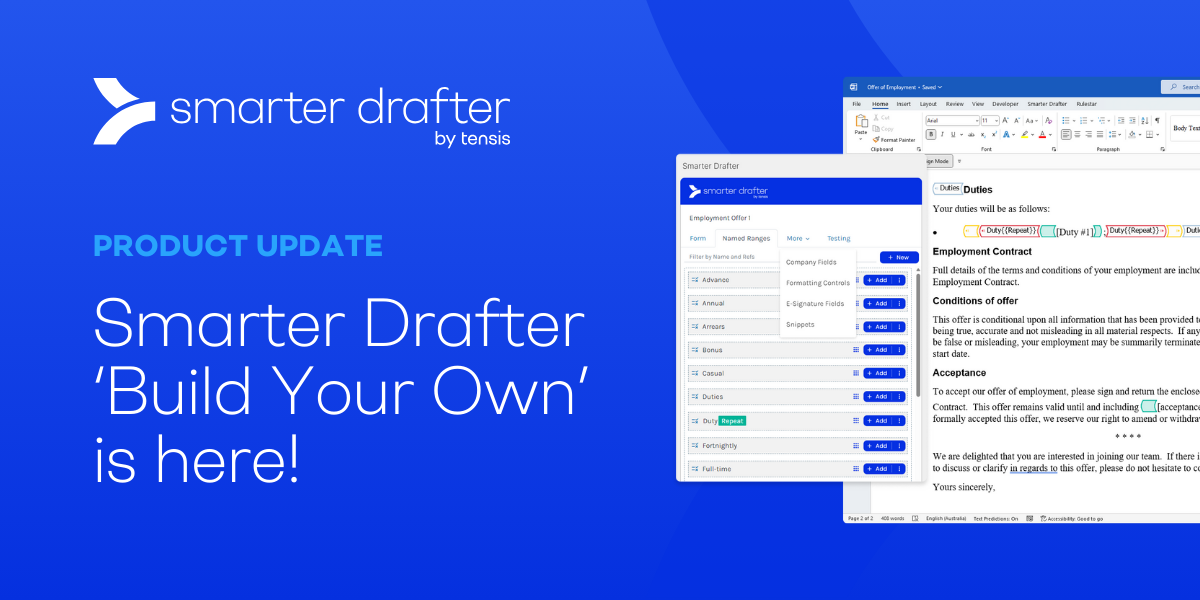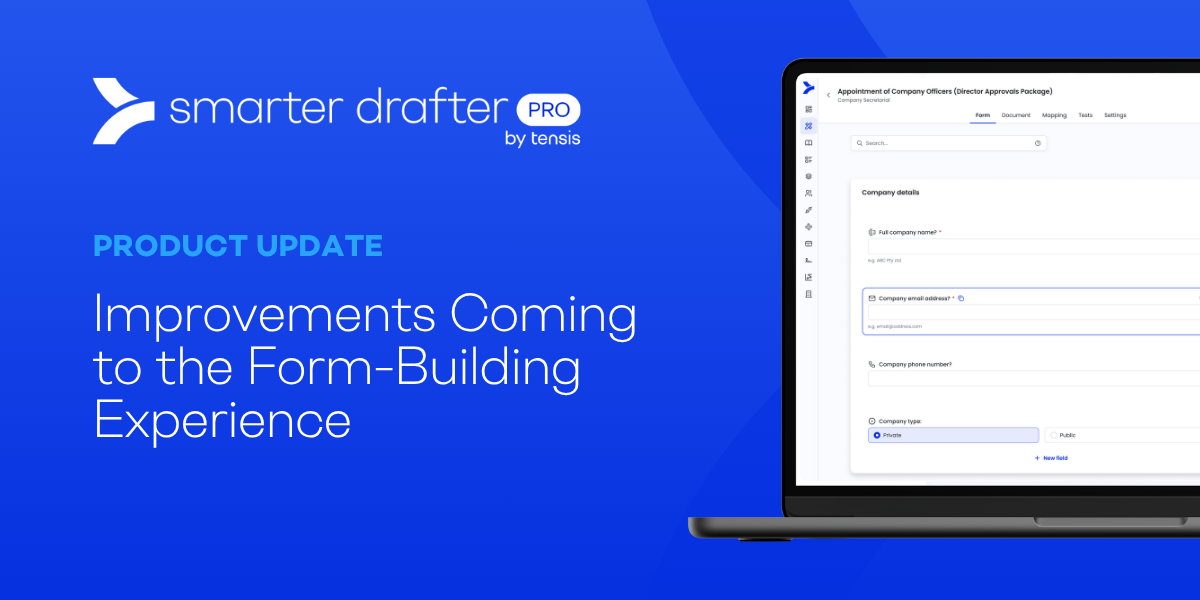
Over the past few months, our Product team has been collecting detailed feedback from Smarter...
 ·
3 minute read
·
3 minute read
Co-Builder is a team of specialised AI agents that removes the manual work from building legal automations.
Every legal-tech vendor is now being asked what they're doing with AI. It's a fair question, and the easy answer is to bolt a chat window onto the product and call it done. We didn't want the easy answer. Co-Builder is our real one, and it's worth explaining the thinking behind it, because the shape of the product is a direct consequence of what we believe AI should and shouldn't do in legal drafting.
Start with the position, because everything else follows from it. AI is the intelligence layer. Smarter Drafter is the precision layer. The two are not in competition; they do different jobs. AI is brilliant at understanding intent, reading a document, and proposing structure. It is not, by its nature, reliable at producing the same trusted output every time.
Our customers trust Smarter Drafter precisely because it is: styling, branding, formatting, and content delivered exactly as the firm specified, every time. That determinism is the product. So the question we set ourselves was not "how do we make AI write documents," but "how do we use AI to remove the work that stands between a firm and a working automation, without touching the determinism that makes the output trustworthy."
The problem was never the runtime
The value of document automation has never been in doubt. Automate your cost agreements, engagement letters, leases, and wills, and you get hours of fee-earner time back per matter, no drift between precedents, and output that's consistently branded and legally sound. Firms know this. It's why the category exists.What gates the category is what it takes to get there. Building an automation today is a technical, manual project with a steep learning curve. Whoever builds it has to learn a language, plan the form structure, click through hours of interface to create sections and fields, connect the branching logic, write the calculations, identify every placeholder, and test every path a branching form can take. None of that is legal work.
That build-time problem, not the runtime, is what Co-Builder exists to solve.
Why a team of specialised agents
We could have built one generalist AI assistant that tries to do everything: a single model behind a chat box, answering questions and making changes across the whole build.
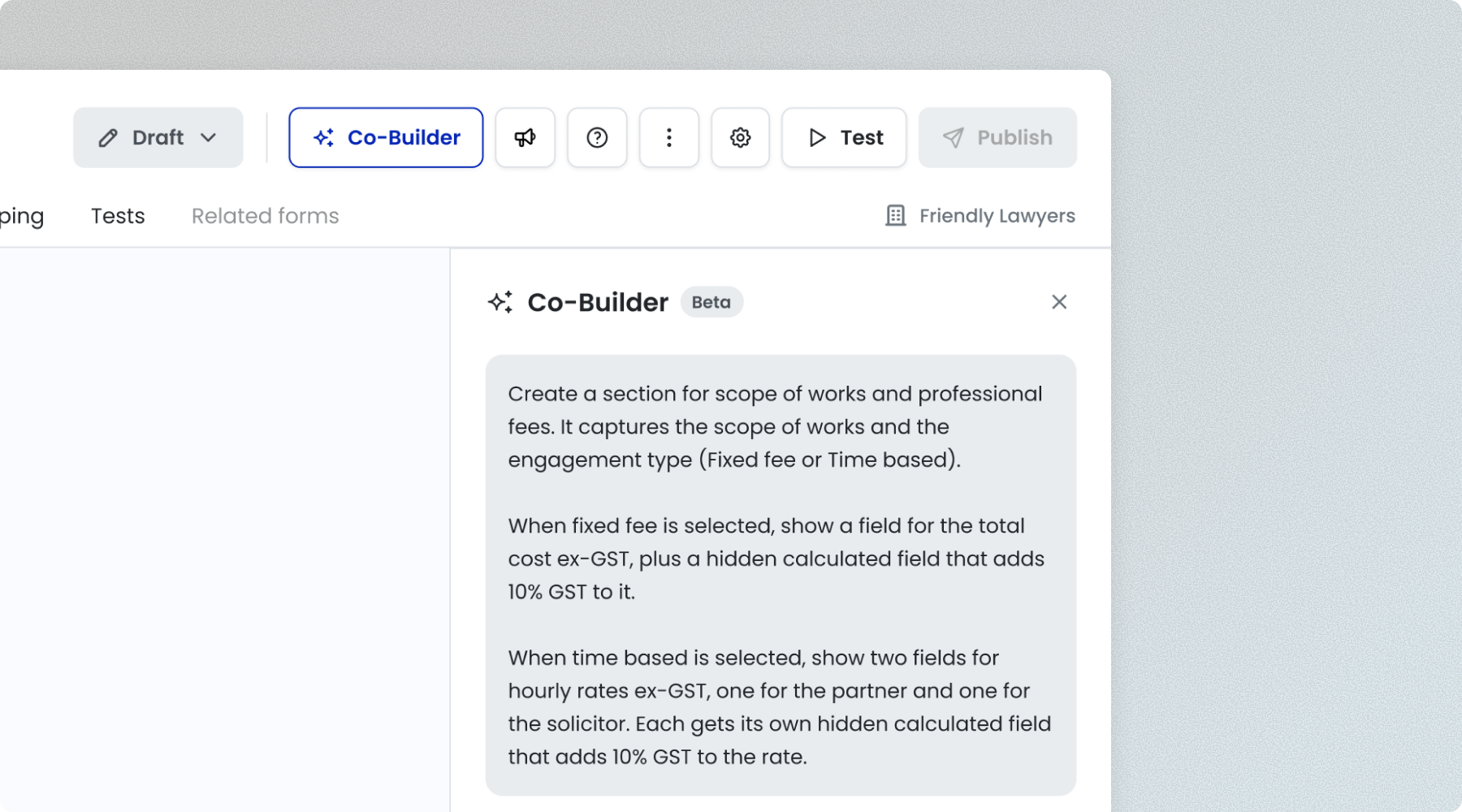
Because the build isn't one task. It's a sequence of distinct phases, each with its own learning curve, its own manual effort, and its own ways to fail. Planning the structure is a different skill from building a form, which is different from wiring conditional logic, which is different again from writing calculations or binding a Word template or testing the whole thing end to end. A generalist trying to cover all of them at once would be strong at chat and weak at the specifics. Builders don't need breadth across a chatbot. They need depth exactly where the work lives.
Co-Builder is built as a coordinated team of specialised agents, each aligned to a real phase of the workflow. The Builder experiences one product, a conversation, a plan-and-approve flow, but underneath, the right specialist handles each part of the job.
The full vision is six agents:
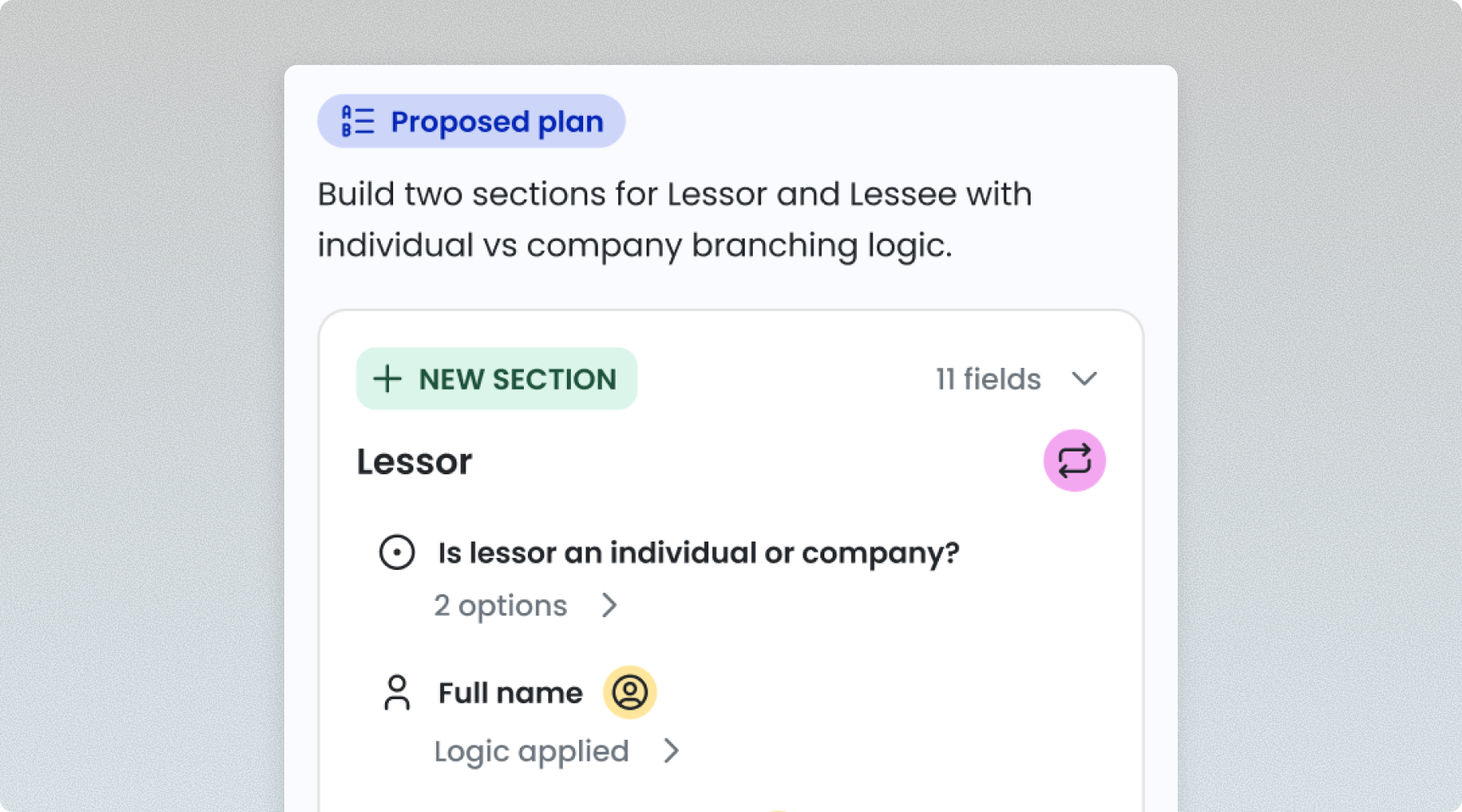
- A Planning Agent that reads a document and proposes a structural plan, removing the blank-canvas problem.
- A Form Agent that turns a sentence like "add a client details section for individuals and companies" into sections and fields.
- A Logic Agent that proposes branching rules in plain language and ties them to the right fields.
- A Calculations Agent that builds fee totals, GST, and derived dates with the inputs and expected behaviour spelled out.
- A Template Coding Agent that binds the form to the document.
- A QA Agent that exercises the branches, runs the calculations, and surfaces anything that looks wrong.
The Builder stays the architect. Co-Builder is the executor that removes the manual work between intent and outcome.
The principles that keep it trustworthy
Four principles hold the whole thing together, and they're worth stating plainly because they're what make an AI feature safe for legal work.
-
AI scaffolds at build time; the runtime stays deterministic. The agents help Builders build. They never generate documents at runtime. The same form fill produces the same document every time, exactly as it does today. Precision drafting remains the product.
-
Lawyer-in-the-loop for every AI action. The legal profession runs on showing your work; how you reached an outcome matters as much as the outcome. Co-Builder is built to that standard. The AI's thinking is visible as it reasons. Every proposal comes with its rationale. Nothing is written to the form, logic, calculations, or template without a plan on the table and a deliberate decision to approve, revise, or reject.
-
AI throughout the journey, not just chat. The chat drawer is the primary surface, but AI also appears inline: through suggestions, buttons, and proactive prompts at the right moments in the build.
-
Security and trust from day one, not retrofitted. Regional data residency, no training on customer data, role-based access, and full auditability of every AI proposal and every Builder decision. Firms can see what was suggested, what was approved, and what was applied — for every template, every time.
Where this leaves us
Co-Builder is our answer to the AI question, and it's a considered one. AI where it genuinely helps: removing the manual heavy lifting from the build. Determinism where it matters most: in the document that goes to a client or a court.The build experience is finally starting to match the runtime experience our customers already trust. That's the whole point.
Co-Builder is in public beta now. If you'd like to see it work on one of your own templates, book a demo and we'll walk you through it.